
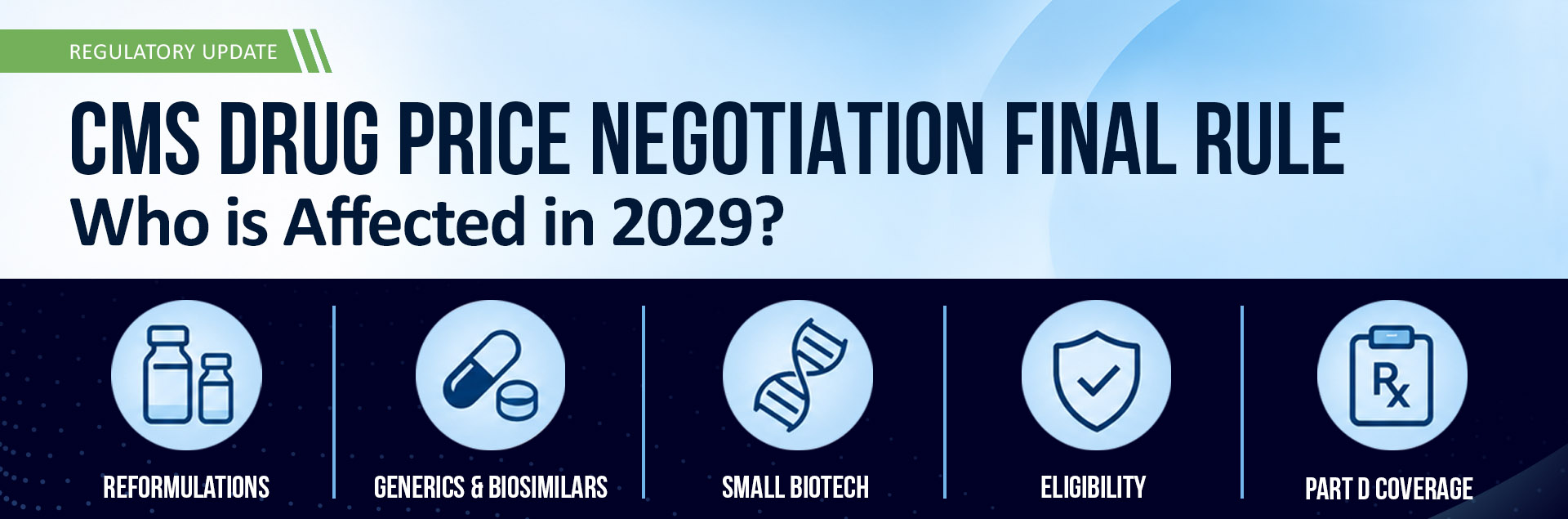
CMS Drug Price Negotiation Final Rule: Who is Affected in 2029?
The Centers for Medicare & Medicaid Services (CMS) has released a final rule addressing the Medicare Drug Price Negotiation Program and related Medicare Part D requirements. The rule primarily affects certain high-expenditure, single-source drugs and biologics covered under Medicare Part B and/or Part D, including drugs being evaluated for selection and those already selected for negotiation.
For pharmaceutical manufacturers without selected drugs, the immediate impact is generally limited, although those with potentially eligible products should monitor the drug selection criteria. The rule does not broadly change requirements across other Medicare or government pricing programs.
The final rule primarily incorporates existing guidance into regulation for the 2029 negotiation cycle and subsequent years, while establishing certain new policies and clarifications. Published in the Federal Register on November 9, 2026, the rule takes effect December 5, 2026, with selection and negotiation activities for 2029 beginning earlier, including during 2027.
Key Provisions of the CMS Final Rule
The following provisions primarily affect drugs being evaluated for eligibility or already selected under the Medicare Drug Price Negotiation Program. They address drug selection criteria, manufacturer responsibilities, and Medicare Part D coverage and payment requirements, rather than imposing broader changes across all pharmaceutical manufacturers.
-
Certain Drug Reformulations May Be Grouped TogetherProducts sharing the same New Drug Application (NDA) or Biologics License Application (BLA) holder may be treated as one drug when CMS identifies qualifying single-source drugs if an added active ingredient enables a different route of administration.Example: An intravenous therapy and a new combination formulation administered by another route could be grouped together, despite separate approvals.
-
Generic and Biosimilar Marketing Affects Drug Selection and DeselectionFDA approval of a generic or biosimilar alone does not prevent selection or remove the original drug from the Medicare Drug Price Negotiation Program. Actual marketing of the generic or biosimilar is required.Example: An approved generic that has not launched would not, by approval alone, end the original drug’s participation in the program.
-
Small-Biotech Protections Change for 2029 and 2030The temporary small-biotech exclusion ends after 2028. For 2029 and 2030, eligible selected drugs receive a negotiated-price floor.Example: A previously excluded drug could be selected for negotiation, but its negotiated price could not fall below the applicable floor.
-
CMS Clarifies Eligibility and Negotiation Program ResponsibilitiesThe final rule establishes that negotiation obligations continue when a selected drug is acquired, with CMS approval required to transfer the agreement. It also clarifies eligibility for former orphan drugs, pricing calculations for one-time Medicare Part B therapies, and how certain off-label uses may be considered for renegotiation.Example: Acquiring a selected drug does not automatically reset its negotiated price or end its obligations under the program. Transferring the negotiation agreement requires CMS approval.
-
Medicare Part D Coverage and Payment Requirements Are CodifiedMedicare Part D plans generally must include covered Part D drugs selected for negotiation that have a Maximum Fair Price (MFP) in effect on their formularies, subject to certain exceptions. Negotiated payment prices are capped at the Maximum Fair Price (MFP) plus applicable dispensing fees.Example: A $500 Maximum Fair Price caps the applicable negotiated payment price at $500 plus dispensing fees. It does not establish a competing product’s price or determine the patient’s out-of-pocket cost.
What Does the Final Rule Mean for Pharmaceutical Manufacturers?
Manufacturers competing with drugs selected for negotiation may wish to assess potential commercial implications, even if their own products have not been selected.
For most other manufacturers, routine monitoring of the Medicare Drug Price Negotiation Program, future drug selections, and related developments should be sufficient.
Navigating an Evolving Regulatory Landscape
As the pharmaceutical industry continues to navigate an evolving regulatory landscape, Prescription Analytics, Inc. partners with pharma and device manufacturers to support their growth, profitability, and compliance objectives.
Our team combines government pricing expertise with practical, ongoing support to help manufacturers navigate regulatory requirements while advancing their broader business goals.
Contact us today to explore how a partnership with Prescription Analytics can support your organization.
Source:
Centers for Medicare & Medicaid Services (CMS), “Medicare Drug Price Negotiation Program and Medicare Prescription Drug Benefit Program Final Rule (CMS-4215-F),” November 5, 2026.
Federal Register, “Medicare Drug Price Negotiation Program and Medicare Prescription Drug Benefit Program,” 91 FR 72176, November 9, 2026.

Jeremy Lajoice
Chief Compliance Officer
"*" indicates required fields
If you’re looking for a long-term relationship with industry experts who are always available to help you leverage opportunities and mitigate threats, contact us today.
